

Find and sell homes faster in Middle Tennessee
If you’re thinking about selling your home, buying your next one, or just trying to figure out what makes sense for your family right now… you’re in the right place. This blog is built specifically for homeowners and buyers in Davidson County and surrounding areas who want real answers—not guesses. You’ll find clear breakdowns, local insight, and step-by-step guidance so you can make smart decisions with confidence, whether you’re moving up, buying your first home, or just exploring your options!
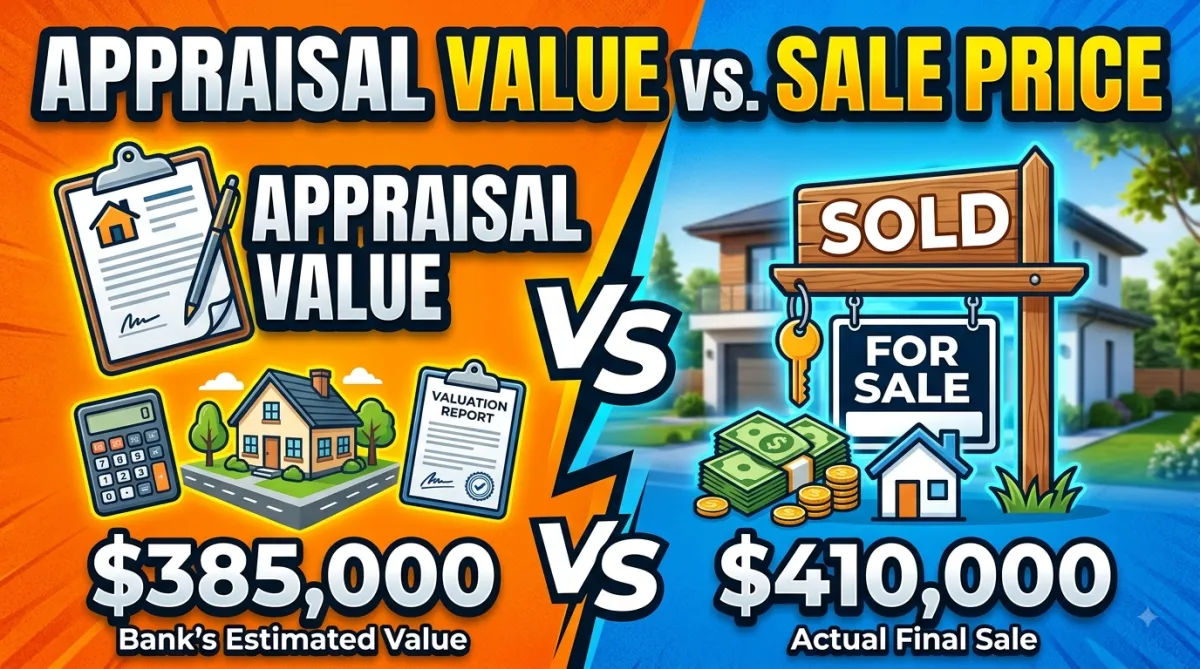
Appraisal Value vs. Sale Price: What's the Difference?
Appraisal Value vs. Sale Price: What's the Difference?
Appraisal Value vs. Sale Price at a Glance3
Why Can the Appraisal and Sale Price Be Different?4
1. Buyers May Compete for a Property1
2. The Seller May Have Priced the Home Aggressively2
What Happens If the Mortgage Appraisal Comes in Low?5
Does a Low Appraisal Mean the Seller Has to Lower the Price?6
Tennessee Property Taxes: A Different Kind of "Appraisal Value"7
Can You Challenge a Tennessee Property Assessment?8
What Sellers Should Remember11
If you’re buying or selling a home in Tennessee, you may hear two numbers discussed throughout the transaction: the appraisal value and the sale price. While these numbers can be similar, they are not necessarily the same—and understanding the difference can help you make better real estate decisions.
A home can sell for more than its appraised value, less than its appraised value, or almost exactly at the appraised value. In Tennessee, there is also an important distinction between an appraisal used for a mortgage and the appraised value used by a county assessor for property-tax purposes.
Here’s what Tennessee buyers and sellers should know.
What Is Appraisal Value?
An appraisal is an estimate of a property's value based on factors such as its location, size, condition, features, and comparable properties.
For Tennessee property-tax purposes, the county assessor determines the property's appraised value. The Tennessee Comptroller's Office describes appraised value as an estimate of the property's most probable selling price.
However, when you're buying a home with a mortgage, the appraisal is typically a professional valuation used by the lender to evaluate the property. The mortgage appraisal is different from the value shown on your county property-tax record.
This distinction is especially important when a buyer has agreed to pay one price but the lender's appraisal comes in at another value.
What Is Sale Price?
The sale price is the amount a buyer and seller agree to pay for the property in an actual transaction.
For example, suppose a home in Nashville is listed for $450,000 and a buyer and seller agree on a purchase price of $440,000. The sale price is $440,000.
The sale price reflects what that particular buyer was willing to pay for that particular property under the circumstances of that transaction.
Market conditions, competition among buyers, seller motivation, negotiations, upgrades, location, and timing can all influence the final sale price.
Appraisal Value vs. Sale Price at a Glance
Appraisal ValueSale PriceAn estimate of valueThe actual negotiated purchase amountBased on an appraisal processDetermined by buyer and sellerMay consider comparable sales and property characteristicsReflects the specific transactionUsed by lenders when financing a homeDetermines what the buyer actually paysCounty appraised value is also used in Tennessee's property-tax systemRepresents the price agreed to in a sale
One important Tennessee-specific point: county appraised value should not be confused with assessed value. For residential property in Tennessee, the statutory assessment ratio is 25%. The assessed value is calculated by applying that percentage to the county's appraised value, and the local tax rate is then applied to the assessed value.
Why Can the Appraisal and Sale Price Be Different?
There are several reasons.
1. Buyers May Compete for a Property
In a competitive Tennessee market, multiple buyers may want the same home. A buyer could offer more than what an appraiser ultimately determines the property is worth.
For example:
Agreed sale price: $500,000
Mortgage appraisal: $480,000
Difference: $20,000
The property isn't automatically "worthless" or unsellable because of the difference. Instead, the appraisal indicates that the appraiser's opinion of value is below the negotiated contract price.
2. The Seller May Have Priced the Home Aggressively
A seller can set an asking price based on expectations, recent neighborhood activity, improvements, or advice from a real estate professional.
But the lender's appraiser must independently analyze the property and relevant comparable sales.
The Tennessee Comptroller notes that the sales-comparison approach considers recently sold properties with similarities in size, quality, use, and amenities, with adjustments made for relevant differences.
3. The Market Can Change
Tennessee's property-tax appraisal system operates on periodic reappraisal cycles rather than necessarily updating every property's value every year. Depending on the county, reappraisal occurs on a four-, five-, or six-year cycle. Between reappraisals, values generally remain constant unless certain changes occur to the property.
That means a county's tax appraisal may not match the price a home could command in today's market.
A home could have a county appraised value of $300,000 and sell for $400,000 without that automatically meaning something is wrong with the transaction.
What Happens If the Mortgage Appraisal Comes in Low?
This is one of the most important situations for Tennessee home buyers and sellers.
Suppose you agree to purchase a home for $400,000, but the lender's appraisal comes back at $380,000.
The lender may be unwilling to lend based on the full $400,000 purchase price because the appraisal provides an independent opinion of the property's value.
The buyer and seller may then negotiate.
Possible outcomes can include:
The seller reduces the price.
The buyer brings additional cash to closing.
The parties negotiate another solution allowed by the purchase contract.
The buyer proceeds if the financing and contract terms allow it.
The transaction is canceled if the applicable contract provisions permit it.
The Consumer Financial Protection Bureau recommends getting a copy of the appraisal and notes that a lower appraisal can provide evidence for negotiating a lower purchase price.
Does a Low Appraisal Mean the Seller Has to Lower the Price?
No.
An appraisal does not automatically force a seller to reduce the sale price.
The seller may decide to keep the agreed price, particularly if there are other interested buyers or if the seller believes the appraisal doesn't fully reflect the property's market value.
The buyer, however, must consider whether paying above the appraised value makes financial sense and whether the lender will provide enough financing to complete the purchase.
This is why understanding the terms of the purchase contract and financing arrangements is important.
Tennessee Property Taxes: A Different Kind of "Appraisal Value"
Tennessee homeowners should be particularly careful when comparing a county's property value with a home's sale price.
The county assessor's appraised value is part of the state's property-tax system. Tennessee then applies the statutory assessment ratio based on the property's classification.
For residential property, the assessment ratio is 25%. For example, a home with a county appraised value of $400,000 would have an assessed value of $100,000 before the applicable local tax rate is applied.
So if a Tennessee home sells for $450,000 while its county appraised value is $350,000, you should not assume that the owner is paying property taxes on $350,000. The tax calculation involves the county's appraised value, the applicable assessment ratio, and the local tax rate.
Can You Challenge a Tennessee Property Assessment?
Yes. Tennessee property owners have avenues for appealing property assessments when they believe the value or classification is incorrect.
The Tennessee State Board of Equalization explains that evidence such as comparable property sales can be important in an appeal. Relevant factors can include square footage, acreage, age, condition, location, features, and the date of sale.
Homeowners can also review Tennessee property assessment information through the state's property assessment database, which provides access to county assessor data for most Tennessee counties.
A Simple Tennessee Example
Imagine you're buying a home in Knoxville.
The numbers look like this:
County appraised value: $325,000
Mortgage appraisal: $390,000
Agreed sale price: $400,000
These three numbers can legitimately be different because they serve different purposes.
The county appraised value is part of the property-tax system. The mortgage appraisal is a professional valuation used in the financing process. The sale price is what the buyer and seller agreed to pay.
The fact that all three numbers are different does not necessarily indicate a problem.
What Buyers Should Remember
If you're purchasing a home in Tennessee, don't look at just one number.
Consider:
The agreed sale price — what you are actually paying.
The mortgage appraisal — important to your lender and financing.
Comparable recent sales — useful for determining whether the price is reasonable.
The county's appraised value — relevant to property taxes, but not necessarily a current indication of what a buyer will pay.
Your purchase contract and financing terms — these determine what options may be available if an appraisal comes in below the contract price.
What Sellers Should Remember
For sellers, an appraisal that comes in below the contract price can create a challenge, but it doesn't automatically mean the home was overpriced.
If you believe the appraisal doesn't accurately reflect the property's value, relevant comparable sales and documentation of meaningful property features or improvements may help explain the difference.
However, the buyer's financing situation still matters. A seller should understand that the buyer's lender may base its lending decision on the appraised value.
Watch Video: Appraisal Value vs. Sale Price: What's the Difference?
Appraisal value and sale price are two different numbers — and they don't always match. In this video:
Final Thoughts
Appraisal value and sale price answer two different questions.
The sale price tells you what the buyer and seller agreed to pay. An appraisal provides an opinion of the property's value, while a Tennessee county's appraised value is part of the state's property-tax assessment system.
In Tennessee, these distinctions matter because county property values, mortgage appraisals, assessed values, and actual sale prices can all be different.
If you're buying or selling property in Tennessee, understanding which "value" you're looking at—and what that value is being used for—can prevent confusion and help you make a more informed real estate decision.

Theresa Mayer is a dedicated real estate professional who helps buyers find their dream homes while keeping their best interests at the forefront. With a strong focus on strategic negotiation, market knowledge, and client advocacy, Theresa works to ensure her buyers never overpay and secure the best possible terms throughout the transaction. Known for her transparency, confidence, and hands-on approach, she guides clients through every step of the home-buying process with peace of mind. Outside of real estate, Theresa is passionate about helping animals and volunteers at a local dog shelter, bringing the same patience, dedication, and fierce advocacy she shows her rescue pets to the clients she represents.
Theresa Mayer
Real Estate Marketing Expert
Nashville, TN 37076
425-458-8384







Theresa Mayer is a licensed Realtor with eXp Realty in the state of Tennessee and an authority on Middle Tennessee area real estate.
My love for the community where I live, work & volunteer, are why I do what I do.
Let's connect!
(425) 458-8384
888-519-5113 x:1083
All Rights Reserved By Theresa Mayer, Realtor